Solar power can reduce electricity costs and help keep homes and businesses running when the public power supply is unavailable. But while solar energy offers major benefits, its electrical and battery components introduce fire risks that building owners should not overlook.
Solar panels, inverters, batteries, cables and electrical connections can generate heat and electrical faults. In battery rooms and plant rooms, the combination of electrical equipment, dust, heat and lithium batteries makes early fire detection particularly important.
One of the key differences between solar installations and ordinary household electrical circuits is DC electricity.
Solar panels continue producing direct current when exposed to light. If a cable is damaged, a connector becomes loose or an electrical connection is poorly installed, an electrical arc can continue until the circuit is properly isolated. Poor-quality connectors, damaged cables, incorrect terminations and improper installation can therefore create serious fire hazards.
Heat is another important concern.
Inverters and combiner boxes can become hot during operation, particularly when installed in poorly ventilated, dusty or enclosed areas. Battery cabinets can also generate significant heat. If equipment overheats and the problem is not detected early, a small electrical fault can develop into a serious fire.
The installation environment can make the risk worse. Dust and debris around solar equipment, combustible materials stored close to batteries, blocked ventilation and inaccessible isolation switches can make both prevention and emergency response more difficult.
That is why professional installation and regular inspection should come before fire detection.
Solar panels and electrical equipment should be installed with adequate clearance and ventilation. Isolation points should be accessible and clearly identified. Cables and connectors should be inspected periodically, particularly after storms, roof maintenance or other work around the installation.
Combustible materials, cartons, fuel and other unnecessary items should also be kept away from inverter and battery areas.
Most importantly, occupants and emergency responders should know how the solar installation can be safely isolated during an emergency.
Fire detection does not replace these precautions. Instead, it provides an additional layer of protection by giving people an early warning when a developing fault has become a fire.
Choosing the Right Fire Detector for Solar Equipment Rooms
The type of detector installed is important.
Inverter rooms, battery rooms and other plant rooms can experience heat, dust and changing environmental conditions. In these areas, heat detection can be more appropriate than conventional smoke detection, depending on the specific environment and system design.
A suitable conventional heat detector can provide early warning when temperatures rise abnormally. An AH mechanical rate-of-rise heat detector can also be considered for appropriate applications.
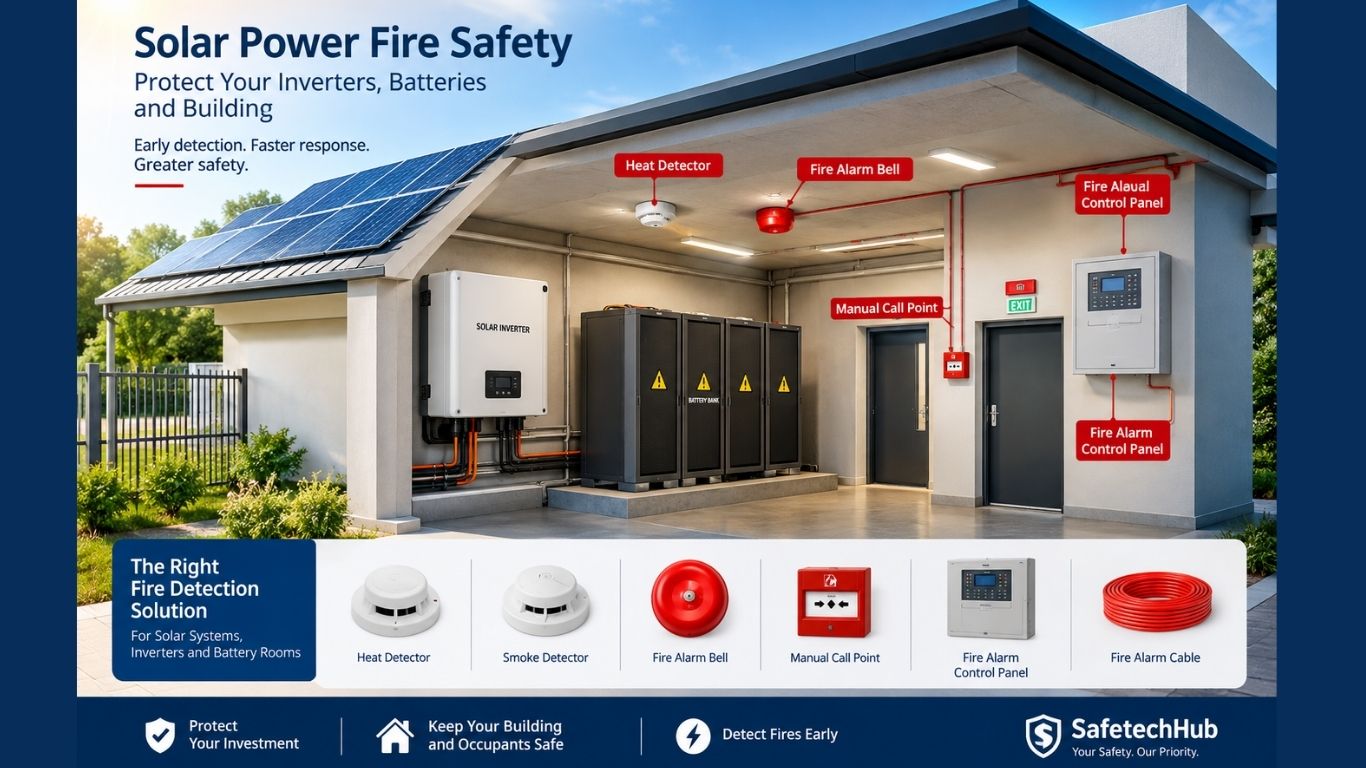
A fire alarm bell should be installed so that an alarm can be heard clearly, while a manual call point near an exit gives occupants a way to activate the alarm manually if they discover a fire before the automatic detector operates.
For example, a solar inverter or battery room could have a heat detector, manual call point and fire alarm bell connected to a central fire alarm control panel.
However, rooms occupied by people require a different approach.
Offices, homes, stores, corridors and living areas are generally better suited to smoke detection. Depending on the application and system design, options can include an AH photoelectric smoke detector, C-TEC ActiV optical smoke detector, or standalone Wisualarm smoke alarm.
The important principle is to match the detector to the environment rather than installing the same type of detector everywhere.
Connect the Protection to a Fire Alarm Control Panel
For larger installations, individual detectors should be connected to a central fire alarm control panel so that an alarm can be monitored and identified.
For homes and small shops, a Wisualarm 4-Zone Fire Alarm Control Panel can provide a practical conventional fire alarm solution.
For larger buildings such as warehouses, schools, hotels and commercial facilities, an 8-zone panel, such as the Wisualarm 8-Zone Fire Alarm Control Panel or Zeta Infinity 8, can provide additional zone capacity.
The appropriate panel and system configuration should always be selected according to the building layout, number of detection zones, applicable standards and the requirements of a qualified fire alarm professional.
Fire alarm cabling should also be correctly selected and installed for the system. Appropriate fire-resistant cable, correct termination and suitable battery backup are essential to maintaining system reliability.
A properly backed-up fire alarm system can remain operational even when another electrical system, including an inverter, experiences a fault or loses power.
A Practical Solar Fire Detection Layout
A simple fire detection arrangement for a building with solar equipment could include:
Inverter/Battery Room
- Heat detector
- Manual call point near the exit
- Fire alarm bell
- Appropriate fire alarm control panel connection
Adjacent Office, Store or Living Area
- Photoelectric smoke detector
- Additional detection where required
Building
- 4-zone or 8-zone conventional fire alarm control panel, depending on the size and design of the installation
- Appropriate fire alarm cabling
- Battery backup
- Clearly identified alarm zones