The fire incident that affected 21 exotic vehicles at a mechanical workshop in Isheri-Idimu, Lagos, has renewed attention on the importance of early fire detection, intelligent monitoring and properly designed fire protection systems in commercial and industrial facilities.
A fire outbreak at a mechanical workshop in the Isheri-Idimu area of Lagos State on Friday, October 30, 2026, reportedly affected 21 exotic vehicles and damaged part of a neighbouring building. The incident has raised important questions about how businesses can better protect valuable assets, employees, customers and surrounding properties against fire emergencies.
According to the Lagos State Emergency Management Agency (LASEMA), its response team, alongside the Lagos State Fire and Rescue Service, the Lagos Neighbourhood Safety Corps and the Nigeria Police Force, responded to the incident. The fire was eventually extinguished, and no casualties or injuries were reported.
Although the cause of the fire remains subject to investigation, the incident highlights a critical lesson for vehicle dealerships, automobile workshops, warehouses, factories, hotels, shopping centres and other commercial establishments: fire safety should begin long before smoke or flames become visible.
For businesses that store expensive vehicles, equipment, inventory and other valuable assets, relying solely on manual observation or waiting for someone to notice a fire can leave too little time for an effective response.
A properly designed fire protection strategy combines early detection, automatic alarm activation, clear emergency notification, appropriate monitoring technology and regular system maintenance.
Early fire detection: The first line of protection
One of the most important components of a fire protection system is the ability to detect potential fire conditions early and alert people in the building.
Smoke detectors identify smoke particles and provide an early warning of a possible fire. Heat detectors respond to temperature increases and are particularly useful in environments where smoke detection may not be suitable, such as certain workshops, kitchens, garages and industrial areas.
For larger facilities, addressable fire alarm systems provide more detailed information about the location of an alarm. Unlike basic conventional systems, which generally identify the affected zone, an addressable system can identify the individual detector or device reporting an alarm, subject to the system configuration.
This helps security personnel, facility managers and emergency responders identify the affected area more quickly.
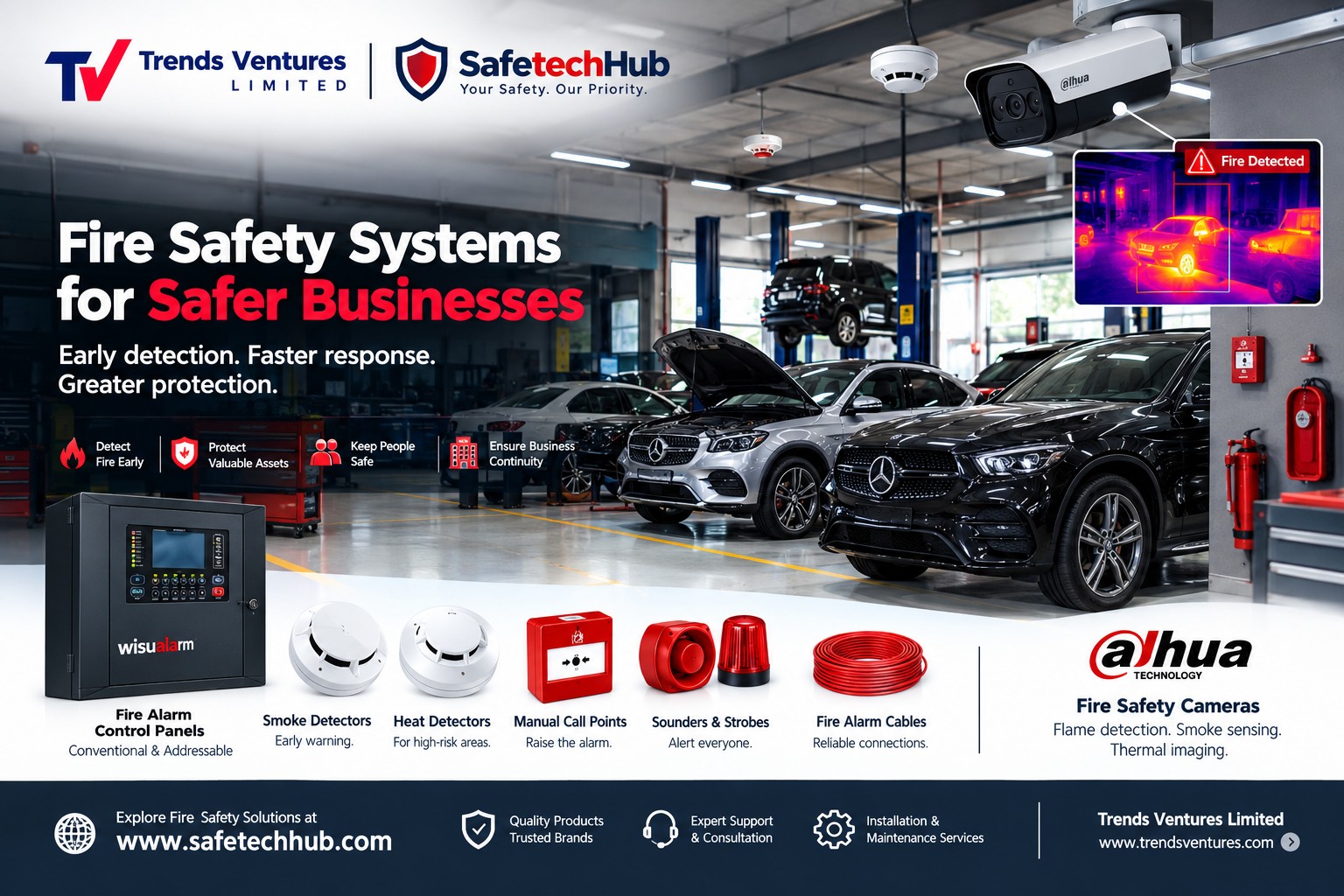
SafetechHub, the e-commerce division of Trends Ventures Limited, provides access to fire alarm products and components, including smoke detectors, heat detectors, manual call points, alarm sounders, fire alarm control panels and fire alarm cables.
These products support different fire detection requirements, from smaller premises to larger commercial and industrial installations.
Fire alarm control panels: Coordinating the response
A fire alarm control panel serves as the central monitoring and control point of a fire detection system. It receives signals from connected detectors and other devices, identifies alarm or fault conditions and activates the appropriate notification devices.
For businesses with multiple rooms, floors, workshops or storage areas, selecting the right control panel is essential.
Conventional fire alarm panels are commonly used in smaller or simpler installations where identifying the affected zone is sufficient. Addressable fire alarm panels are suitable for more complex facilities where identifying the specific device reporting an alarm can improve response and fault management.
SafetechHub offers conventional fire alarm panels, including Wisualarm four-zone and eight-zone panels, as well as other fire alarm system components. The appropriate configuration should be determined by a competent fire safety professional after assessing the building’s size, layout, occupancy and fire risks.
Fire Safety Cameras: Adding intelligent visual and thermal monitoring
Traditional CCTV cameras help security teams observe activities around a property, but specialised fire-safety cameras can provide additional monitoring capabilities.
Dahua Fire Safety Cameras include flame-detection and smoke-sensing camera categories designed to support fire monitoring. Depending on the model, these cameras use thermal imaging and intelligent image analysis to identify potential fire-related conditions, such as flame patterns, smoke or unusual temperature changes.
Thermal imaging is particularly useful because it can identify temperature differences that may not yet be obvious on an ordinary visible-light camera. This can help operators monitor areas where equipment, stored materials or other conditions may create fire risks.
For example, a vehicle workshop may have vehicle storage areas, electrical installations, equipment rooms and sections where flammable materials are handled or stored. A suitably designed camera system can provide additional monitoring of these locations.
Dahua’s fire-safety camera range includes models such as the HY-FT443HFP, HY-FT443MFP, HY-FT431LFP and HY-FT431LDP-MB. Product capabilities vary by model, but selected models support thermal monitoring, flame detection and intelligent alarm functions.
For businesses seeking additional visibility over high-risk areas, these cameras can complement conventional fire detection and CCTV systems. They should not, however, be treated as replacements for properly designed fire alarm systems, smoke detectors, heat detectors or other required fire protection measures.
Smoke and heat detection for different environments
Not every area of a building requires the same type of detector.
Smoke detectors are commonly used in offices, corridors, reception areas, bedrooms and other suitable indoor locations. Heat detectors may be more appropriate in environments where normal operations generate dust, fumes, steam or other conditions that could affect smoke detection.
In workshops, garages, kitchens, plant rooms and industrial facilities, a professional assessment helps determine the most appropriate detector type and positioning.
SafetechHub supplies different fire detection devices, including standalone smoke alarms, conventional smoke detectors, addressable smoke detectors and heat detectors.
Choosing the correct device and installing it in the appropriate location are both important. Incorrect placement, unsuitable detector selection or inadequate maintenance can undermine the effectiveness of a fire detection system.
Manual call points, sounders and alarm notification
Automatic detection is only one part of an effective fire alarm arrangement. People who discover a fire before an automatic detector activates must also have a way to raise the alarm.
Manual call points allow occupants to activate the fire alarm system during an emergency. Alarm bells, electronic sounders and sounder-strobe devices then help notify people within the affected premises.
In larger buildings, alarm notification should be designed to ensure that occupants can recognise the warning and follow the established evacuation procedure.
SafetechHub also provides manual call points, alarm bells, sounders and related fire alarm accessories for compatible installations.
Fire alarm cables and reliable system connections
A fire alarm system depends on more than detectors and control panels. Its cables and connections are also important to the overall reliability of the installation.
The correct fire alarm cable must be selected according to the system design, installation environment, applicable standards and project specifications. Cable routing, protection, termination and testing should be handled by qualified installers.
SafetechHub stocks fire alarm cables in different sizes and lengths, including 1.5mm and 2.5mm options and products specified for fire alarm applications.
Using suitable cables and ensuring that the entire installation is properly tested can help maintain dependable communication between compatible fire alarm devices.
Why businesses need an integrated fire safety strategy
A workshop or dealership storing several high-value vehicles requires a different level of planning from a small retail shop. The same applies to factories, warehouses, hotels, schools, hospitals and multi-storey commercial buildings.
An effective fire safety strategy should consider:
The type of materials and equipment stored or used on the premises.
The likelihood of electrical, mechanical or other fire hazards.
The location and suitability of smoke and heat detectors.
The capacity and configuration of the fire alarm control panel.
The positioning of manual call points and audible or visual alarm devices.
The use of CCTV and specialised fire-safety cameras where appropriate.
Emergency exits, evacuation arrangements and staff awareness.
Routine inspection, testing and maintenance of installed equipment.
Where necessary, fire detection and alarm systems can be integrated with other building safety systems, subject to compatibility and proper engineering design.
It is also important to remember that cameras and alarms do not extinguish fires. Depending on the building’s risk assessment and applicable requirements, additional protection such as suitable fire extinguishers, automatic suppression systems, emergency lighting and other safety measures may be necessary.
Trends Ventures Limited: Fire safety solutions for businesses and facilities
Trends Ventures Limited is a Nigerian safety and security engineering company involved in the supply, installation and maintenance of electronic safety and security systems.
Through its SafetechHub platform, the company provides access to a range of fire alarm and detection products, including conventional and addressable fire alarm systems, smoke detectors, heat detectors, manual call points, control panels, sounders and fire alarm cables.
Trends Ventures also works with established fire detection and safety technology manufacturers, offering solutions for different project requirements.
For organisations planning a new fire alarm installation, upgrading an existing system or reviewing the safety arrangements of their premises, professional assessment is an important first step. The right solution should be based on the building’s layout, operational activities, potential fire hazards and applicable safety requirements.
Protect your property before the next fire emergency
The Isheri-Idimu workshop fire is a reminder that valuable property can be affected by a fire outbreak, and that early warning and effective emergency planning matter.
Whether you operate an automobile workshop, car dealership, warehouse, office, hotel, school, factory or residential complex, investing in an appropriately designed fire detection and alarm system can improve your ability to identify an emergency and respond promptly.
Do not wait for a fire incident before reviewing your property’s fire safety arrangements.
Explore fire alarm systems, smoke and heat detectors, alarm control panels, manual call points, fire alarm cables and other safety products at SafetechHub.